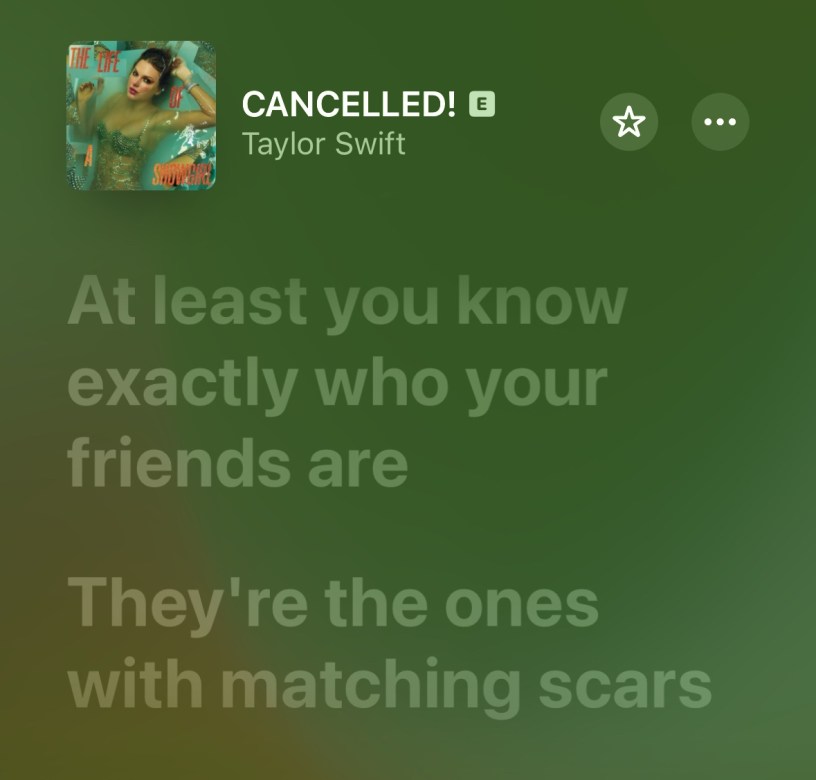
Why do we cancel someone? Do people always deserve it? Is it just for celebrities? Is it all just a joke? Is it offensive to joke about? Is it bad to ever befriend a person who is cancelled? These are just some of the questions that come to mind when trying to think through criticism of yet another track on Taylor Swift’s most recent album release: Cancelled!
The song, an upbeat anthem declaring Good thing I like my friends cancelled/I like ’em cloaked in Gucci and in scandal is a continuation of a theme she’s incorporated in every album since at least the release of Reputation but arguably harkens back to even earlier tracks like Mean’s chorus, someday I’ll be big enough so you can’t hit me.
Self aware of her critics, in this genre of song Swift declares an unabashed confidence in her own success and choices, pitting herself (and, yes, often her friends too) against those who just don’t seem to get her, ultimately dismissing their critiques as not worth her time but owning the labels people throw at her. She has her reasons, she believes in herself, and she’s her own best advocate. Call her a snake? Well she will turn that around and make your snake a core part of her lore and visual legacy.
These tracks inevitably invite further criticism like an ongoing clap back because they exist as part of an ever evolving high profile public conversation about her fame and success, as well as the microscope placed on her private life. The most recent online reactionary claim, like Wi$H Li$t, is that this song is yet another example for how Swift is supposedly revealing her true MAGA colors.
At the risk of publishing one of those dreaded soliloquies she will never see, the following is a thorough discussion of the concept of cancellation in popular usage, what the song appears to mean in light of her discography, how this relates to relationships with MAGA supporters, and finally what the message of the song should mean to each of us.
To begin we need to explore what the title concept of “cancelled” means because the term has become so loaded and confused in popular expression it leaves room for a lot of misunderstanding.
Take this recent interview of the actor Glen Powell on his attempt to talk through the whole idea of being cancelled and how people respond to it, starting with a story about a “recently cancelled” celebrity he ran into at a party:
“He came up and he said nice to meet you, and I was like, ‘Oh, dude, big fan.’ And then a photographer said, ‘Hey, can we take a picture of the two of you guys?’ And this person was recently cancelled and was, as of late, not good,” Powell said.
“I was a fan of their work but not a fan of their choices, right? So I was just kind of being nice, but then when they want to take a picture with you, I realized very quickly how I was like I don’t know if this is a good idea. He clearly clocked that I was like ‘this is probably not a good idea,'” the actor said. “This guy, his face is toxic,” Powell went on to say. “You know, like going out into the world, like people are having a visceral reaction to this person in terms of the bad choices they’ve made.”
He connected the awkward interaction to his character in the upcoming series Chad Powers, a disgraced college football star who returns to the field in disguise and under a new alias. “The character that I play in Chad, it’s like Russ Holiday is a guy that just made a mistake, right? He’s not a bad guy,” Powell said.
He concluded that some reputations, however, are earned. “Some of these other people that get canceled, they should lie where they’re shot,” Powell said.
This entire exchange is so helpful as we try to think through the larger question of whether or not we should take pride in having “cancelled” friends, as Swift’s song declares.
Powell’s interview picks up on essentially three different kind of scenarios when we might use the concept of cancellation: 1) A person with truly problematic personal choices but a still active or respected professional life; 2) A person who “makes a mistake” but isn’t all that bad; and 3) A person who deserves no private or public respect or place in our common social life.
Leaving aside if we agree with Powell on how he’d decide which person matches with each category, I think this is a pretty helpful way to look at the term. Because each of these three categories imply very different reactions are necessary, they also imply very different kinds of crimes or anti-social behavior took place.
What’s striking about Cancelled! the song and the present discourse it inspired is that Taylor Swift is almost certainly referencing the second category, of people who are good but sometimes make mistakes (real or perceived) and from her perspective therefore deserve loyalty in friendship or second chances.
It's easy to love you when you're popular
The optics click, everyone prospers
But one single drop, you're off the roster
"Tone-deaf and hot, let's fucking off her"
A poor taste joke or public comment, ambition gone wrong, cheating in a relationship, “one single drop”. The image she paints here of cancellation, and one that she has referenced in the past using different terminology, is of a trigger happy kind of condemnation, the sort that thrives off social media mobs and puritanical standards, where there is little room to talk it out and when people are not given the benefit of the doubt regarding intentions or potential misunderstandings.
Cancelled! is also about the double standards placed on women when it comes to this more widely applied type of “cancellation”. There are echos of her past songs like The Man or Mad Woman in these lyrics which point to how behaviors widely accepted in a man are viewed as controversial or unacceptable and worth chastising in a woman.
You thought that it would be okay, at first
The situation could be saved, of course
But they'd already picked out your grave and hearse
Beware the wrath of masked crusaders
Did you girlboss too close to the sun?
Did they catch you having far too much fun?
Come with me, when they see us, they'll run
Something wicked this way comes
...
Did you make a joke only a man could?
Were you just too smug for your own good?
Or bring a tiny violin to a knife fight?
Baby, that all ends tonight
You hear the same frustration here as in And I’m so sick of them coming at me again/’Cause if I was a man/Then I’d be the man or Every time you call me crazy/I get more crazy/What about that?/And when you say I seem angry/I get more angry.
Just as Father Figure is the latest addition to a collection of songs which explore the saga of her masters being sold against her wishes, Cancelled! is the latest exploration of the fallout from the Kanye/Kim snake pile on as well as the more generic pressures that come with her life of celebrity. This is about mean girls and burn book behavior, not literally the kind of scandal which might land you in prison or which should reasonably result in any person being shunned from even private associations with public figures.
Swift is saying, “raise your hand if you have ever been victimized by an internet mob or people you thought were on your side” because those who know that kind of pain are her friends, the ones with matching scars.
I am not sure it’s quite correct to consider these as true examples of being “cancelled” in how we ideally want to use the term, because it diminishes the necessary social judgment and consequences that more egregious behavior and beliefs ought to warrant in our public and private spheres. This second type of “cancellation” as outlined by Powell is one that could almost come for anyone at any moment and is not really what the concept was originally intended to represent.
And yet I don’t blame celebrities like Swift or Powell for including these kinds of relatable discretions in the list of things that can get you “cancelled” because there is a genuinely held widespread fear – not just among celebrities but also for basically anyone who uses the internet – that one misstep will lead to a social rejection on par with those who commit actual crimes or major offenses.
We don’t have a shared lexicon to explain these differences with clarity or accuracy so instead a huge range of experiences have all been strangely thrown together. Consider how common it is to hear nervous jokes about getting “cancelled” for even the most anodyne of opinions or actions. That’s what Taylor’s song is about.
Have you ever typed out a quick reaction in the comments or sent a half baked post only to log on later to a storm of criticism you never intended to create? Or perhaps you know what it’s like to have a friend group or work clique turn on you, exclude you, or seem to willfully misunderstand or disproportionately punish you?
Maybe this feeling and any resulting consequence is a totally separate kind of experience from what cancellation should mean. But I think we all know that when we hear “cancelled” there is a twinge of concern that one day a certain kind of fury could come for us too, on scales large and small, but all with the potential to wound. These are the kinds of scars Cancelled! is referencing. We might not all wear Gucci but the fear or experience of that specific kind of rejection or pile on is widely relatable.
Paradoxically, it is this feared “all too common” phenomenon of comparatively mild offenses being treated with a similar severity, in Powell’s words, of someone who needs to “lie where they are shot” that makes it harder to actually cancel the truly deserving among us. Because being “cancelled” can’t be for everything and nothing.
We can’t seek to cancel people because they generically “give us the ick”, as frankly many people want to do with Swift, but also make a strong case for why others should be cancelled because their behavior is well outside our socially acceptable norms. So instead we end up using this complex term in our shared vernacular to cover consequences as shallow as light criticism to as serious as losing your job or entire public reputation, for transgressions as varied as a single controversial comment to being exposed as a chronic abuser, sexual predator, or compulsive liar.
This muddled use of the term “to cancel” is a huge problem for our society but it’s not one we are going to resolve today, nor it is it fair to expect that all popular culture references will self correct and restore a proper or justified meaning. We have to grapple with how the word is commonly used right now. It’s not Taylor Swift’s responsibility to change how the word cancelled is widely used before placing it in a song.
Beyond all that, Cancelled! is also about loyalty in relationships, another theme that Swift carries throughout her discography. From Bad Blood to Karma she likes to write about friendships lost and gained, the pain of betrayals and the benefits that come to those who stay as she takes all her friends to the summit.
They stood by me before my exoneration
They believed I was innocent
So I'm not here for judgment, no
For Taylor, this is a pretty clear reference to her friends who stuck by her through the Kanye controversies. If you don’t follow the social side of all this then you might not get that reference, but most likely it’s speaking about people like Blake Lively or Selena Gomez or Gigi Hadid, friends she’s had for a long time who supported her through her scandals and who she, in turn, sought to help through their own. And again, who doesn’t want friends who both understand the kinds of social wounds you carry and who will also stick with you through your darkest times?
We all could use those friends who stay by your side even when it feels like everyone else is abandoning you, when being your friend or supporter is no longer advantageous within your community. To have loyal friends that share your scars is such a relatable desire, one increasingly valuable or even necessary in a world where every foible or bad moment is more likely to be recorded, shared widely, or held against you. To some extent all of us could use a friend or two like this for moments when someone comes at you with the “grave and hearse” chosen in advance.
You get the sense that Cancelled! in this context is used satirically, in how the lyrics exaggerate the danger Taylor’s friends pose and the types of scandal they are dripping in. It is a way of saying hey we didn’t really deserve ALL THAT but it still hurt us anyway and changed who we trust and how we act.
Swift’s use of Cancelled! is self aware that the term is frequently used too lightly, that perhaps also many supposed “scandals” are not justified or blown out of proportion while other more worthy scandals are left in secret or go unpunished. In response she turns the concept into a badge of honor. She is using the term cancelled here the same way she used the image of the snake.
In that same vein, Cancelled! also plays off the thread of songs in Swift’s discography which joke about her friends and their criminal tendencies, including her features with other known members of her underworld: HAIM and Florence Welch. From She thinks I did it but she just can’t prove it to Little did you know your home’s really only/The town you’ll get arrested/So you pack your life away just to wait out/The shitstorm back in Texas, Swift enjoys playing around with the imagery of murder, scandal, and crime – most especially when it comes to her friends.
Macbeth, a murderer, is the something wicked this way comes that is warned about in the borrowed Shakespearean line, another addition to this tongue in cheek fictional lore of their collective life on the run.
This is also where one of the less sympathetic verses of Cancelled comes into play.
But if you can't be good, then just be better at it
Everyone's got bodies in the attic
Or took somebody's man, we'll take you by the hand
And soon you'll learn the art of never getting caught
Not only are these lines suggestive of the coverups in No Body No Crime or Florida!!! but they also seem reminiscent of a major theme of Midnights, that of the pop star as an anti-hero. It plays into the self critical lines, Dear reader The greatest of luxuries is your secrets…Never take advice from someone who’s falling apart. Especially in recent years, Swift has honed in on this theme that no one is perfect, definitely not herself, and that fans and critics should be careful putting her or anyone else on a pedestal.
In this light, Cancelled! reads as part of a long running joke about her oh so dangerous and imperfect friends as well as the ongoing confession of her very real flaws, both of which are themes that reach much further back in time than our present political environment.
Which finally brings us to the charge that this song is somehow a fascist anthem of tone deaf pride in being a terrible person.
While the song was recorded during the European leg of the Eras Tour a lot has happened since then in the world. Most notably, Donald Trump won reelection and took office, ramping up already high social tensions between those who do and do not support his administration, their policies, or the generally threatening, offensive, and bigoted rhetoric that undergirds the MAGA movement.
For those who understand the full implications of the present administration’s policy goals, MAGA affiliated supporters or enablers present a complex grey area in deciding how to handle or “cancel” them socially or professionally. If or when these people warrant social cancellation or rejection is an open question we are wrestling with as a society in real time.
I think broadly, outside the more hard core liberal/left political circles, support for MAGA right now falls culturally somewhere between obviously egregious cancellable social behavior and a sort of annoying personal flaw. A lot of people currently find managing these relationships a hard line to walk, whether you are a major celebrity worried about pr or a private person trying to figure out who to invite to your birthday party or thanksgiving dinner.
Glen Powell, aside from offering three levels of cancellation, also suggested in his comments three different types of responses other people might have towards those who are “cancelled” in one form or another. You might, like Swift in Cancelled!, wish to give them an another chance or firmly stand by them. You could sort of privately support the parts of them you still admire or politely engage in professional settings but stop short of being seen with them in a way that publicly communicates support. Or you could choose to shun them, to leave them lying where they’re shot.
In general I think the middle response is the kind of awkward situationally driven reaction we are talking about when it comes to how our peers interact with the average MAGA supporter.
Most of the public controversies regarding Swift’s relationships at the moment are about connections she now has via her fiancé Travis Kelce, some of whom are known supporters of MAGA and Donald Trump. Her willingness to be seen and photographed in public with them has resulted in criticism and it’s in the context of that criticism which her song Cancelled! has been poorly received online.
It seems important to note that neither she nor Travis have made comments in support of this administration, to the extent either is political they have expressed support for liberal policies or democratic politicians. But both are also well known to take a conciliatory approach to their relationships, including in public. This instinct, to be willing to speak respectfully about or socialize with problematic people whose public views differ from their own stated values, is the primary source of the present controversy which is tangential at best to Swift’s new song.
There are two main events related to this viral claim that they are secretly telegraphing MAGA messages or that Cancelled! is actually about why MAGA critics are wrong to care: the first being her active presence at an after party for Travis Kelce’s Tight End University at known bigot Jason Aldean’s bar in Nashville where they were also photographed with MAGA supporting podcaster bros (taking place about a year after Cancelled! was likely written), the second being her new and ongoing friendship with Brittany Mahomes, the Trump supporting wife of Travis’ teammate and best friend Patrick Mahomes.
To revisit the subject of double standards, it’s worth reiterating these were Travis’ friends and professional connections first. The TEU situation especially highlights how he and his team definitely have an image problem when it comes to the messages he sends about the values he is willing to tolerate or enable and I agree with critics that he needs to publicly address this more clearly or at the very least should learn how to manage it with greater pr sensitivity.
Taken in conjunction with his poorly thought out comments prior to the Super Bowl about the “honor” of having Donald Trump attend there is a growing impression that he and Swift just DGAF about the threats posed by this administration at home and abroad. Both should be more vocal politically right now simply because it’s the right thing to do and it is what all of us ought to be doing. But that seems like a distinct issue from the message of the song in question.
In my opinion a lot of this criticism should be focused on Travis Kelce as a high profile figure in his own right, as a grown man who should know better and be held to a higher standard without making it about his relationship or somehow blaming the woman he’s now engaged to and suggesting it is all her fault if she attends his events and gets photographed with his friends and his professional contacts.
To the extent Swift committed a crime here it was not having the kind of awareness or concern Glen Powell described in knowing who is actually viewed as contemptible enough within her own fan base to damage her reputation or care enough to avoid it. Perhaps you could argue she shouldn’t attend public events at locations like that at all, but she wasn’t the one who organized it, chose the location, or decided on the guest list.
While I wish they’d make choices from a place of authentic rejection for what all these people stand for, they at least should have possessed the same pr savvy of Powell to know when to distance themselves and not either literally or metaphorically “take the picture.” This matters in terms of our public actions because some images carry loaded messages that are toxic, not just to your brand but to your ethical reputation and influence.
We all need public accountability, especially for clearly objectionable core views and actions, and public figures play a key role in helping to publicly enforce that social accountability for others. So when famous people we support make public choices that undermine the needed public accountability for a controversial person it is fair to criticize that behavior. But that is really a separate issue from the message in Cancelled! as a stand alone song.
Whether or not this whole situation is the kind of problem for fans that’s worth eschewing enjoyment of all Taylor Swift’s music over seems subjective and not the kind of topic I am likely to convince you of either way. I just circle back to the conflicted warning she gave us in Dear Reader: You should find another guiding light/Guiding light/But I shine so bright. Pop stars don’t have to be our moral or political guides in order to still make music we can enjoy.
However, we also have to recognize that we are often driven by factors that can be harder to explain or that may look hypocritical from the outside when it comes to personal choices regarding who we associate with in private. That’s where Swift’s observation that these are people with “matching scars” is so insightful. This may be what influences a lot of our willingness to forgive or overlook or hear out or just tolerate certain beliefs with certain friends or family members that we’d otherwise find disqualifying.
The case of Brittany Mahomes is perhaps more complex for this reason. This is a private relationship of Swift’s born from shared life circumstances and a mix of professional and personal connections. Only they know what they mean to each other or how close they really are. It’s quite possible their friendship is a polite one of convenience. Surely we all have people in our lives who we learn to tolerate or include superficially because that is the best option for keeping the peace or staying loyal to other obligations like family or our profession.
It remains the case that nearly all of Swift’s closest and long time friends are committed liberals or (at worst) politically neutral in public. Other long time friends likely to be found in Taylor’s underworld include Maren Morris who publicly called out the Aldean’s anti-trans bigotry and Hayley Williams who masterfully coined “that racist country singer’s bar” regarding Morgan Wallen’s Nashville establishment in her latest single Ego Death at a Bachelorette Party.
So this relationship with Brittany is an outlier very easily explained by the role she plays as the spouse of Taylor’s fiancé’s best friend. Kind of makes you wonder why we rarely give Swift credit for using her massive celebrity to empower all these outspoken friends of hers but always seem ready to tear her down for showing even the smallest acts of kindness or courtesy to anyone we may deem problematic.
But let’s say Brittany has been fully welcomed into the Swift underworld, there are all sorts of reasons why this could be the case and I don’t really think we have enough information to judge her inclusion and decide if it is intrinsically harmful or wrong. Maybe they click personally, maybe they too share matching scars of one sort of another, maybe Brittany is more complicated of a person than she projects in her public appearances. We really don’t know.
Should any of this matter? I am honestly not sure, at least not when trying to enjoy new music which was not intentionally written about this topic, because trying to explain it in even basic terms starts to feel like we have all careened off the pop culture gossip cliff into an abyss of endless unresolvable speculation.
At this point I am less interested in trying to tease out the question of whether having some potentially problematic friends makes Swift an unredeemable MAGA adjacent jerk – I doubt it – and more interested in what the ideas and messages imbedded in Cancelled! can say to the rest of us.
I have been quite open in recent years about how I pulled back from nearly all past relationships with MAGA and Trump supporters. As I was raised in conservative evangelical circles this has amounted to losing the majority of my accumulated social network. But truthfully even I, someone who does not find the generic question of how to manage MAGA relationships all that hard or gray, still have a few exceptions.
For example, there is the former neighbor with a child the same age as mine whose friendship was born out of us being mutually excluded from a clique of the rest of the moms on our street. I am pretty sure she’s voted for Trump all three times although we don’t talk much about it. We relate to other things, like the importance of raising children who are kind and respectful. We aren’t super close, but her friendship has been constant and meaningful as we meet up at least a few times a year for holidays and birthdays so our kids can play and we can catch up on life. The truth is it works for what it is, and it works – in spite of the parts of her I wish were different – because we still have marching scars.
Does my occasional indulgence of this friendship mean I am now MAGA adjacent? Does my private willingness to still engage in small talk together make me a traitor to the values I continue to publicly express? If we posted a picture together on Facebook have I taken a purely private relationship “public” in a way that changes the meaning of that connection or is the public/private boundary frequently confusing to enforce and control in the age of social media?
At some point I think we have to recognize that these are not always easy questions to answer or navigate, whether you are the biggest pop star in the world or a mostly anonymous stay at home mom.
Human connection is complex and can be stupefying even when making choices about our own relationships. So unless we are dealing with capital C cancellation offenses, the rarer type that should unquestionably leave your career and public image dead on arrival, perhaps we need a bit of grace in judging how others choose to organize their own private world and especially who they let in.
Even in the most generous understanding of the criticisms regarding a lack of sensitivity of the times we now live in or the people Taylor has recently been associated with, I don’t think Cancelled! can fairy be described as a thoughtless ode to shamelessly befriending MAGA fascists.
I don’t mean that it’s not valid to ever question why someone would want to open that inner world to people who I would certainly never trust. In fact I have questions and glance askew all the time about relational choices made by politicians and celebrities and even my own family members or friends.
But I also know there is no absolute formula to apply, no firm rule on this topic which we wouldn’t be tempted to break ourselves given the right circumstances. And just because we spend time with a person in a social setting that doesn’t mean they are invited or given unrestricted access to our more intimate underworlds.
Jean Bethke Elshtain, who you might remember if you read my post about Wi$h Li$t, made this really important observation in Public Man Private Woman when trying to tease out roles for both the public and private spheres in our political life: “A world without the possibility for concealment, a world, as the Nazi imperative had it “without shadows,” with no hiding places, nor refuge, nor solace, nor alternative to the force of the public sphere, is a world that invites barbarism or sterility or both” (335).
The darkness experienced in Swift’s private collection of loyal friends, people she chooses for her own reasons, is part of her refuge in a world that wants to dictate every part of her life with obsessive and detailed control:
Yeah, it's a good thing I like my friends cancelled (Cancelled)
I salute you if you're much too much to handle
Like my whiskey sour (I like it),and poison thorny flowers (I love it)
Can't you see my infamy loves company?
Now they've broken you like they've broken me
But a shattered glass is a lot more sharp
And now you know exactly who your friends are (You know who we are)
We're the ones with matching scars
Social media can make it so hard for even regular people, those without a platform or a public career, to maintain a private life where they are free to work out what they believe and decide who they want to become without a rush to judgement or a risk of being broken into pieces.
But that private world, our underworld, is a necessary component in trying to figure out and explore what we stand for. It’s where we get to be authentic in the midst of external social pressures to conform or demands that we not be too much of anything.
In that private world we can make bad choices, we can lean into negative influences, but it’s also where we can find the freedom to explore the edges of our identity, the safety to heal from wounds that keep us wary of the public square, and a place to interrogate our sense of justice, truth, morality, and equality.
These private realms help us refine core principles in the presence of trusted relationships. It’s where we can stretch ourselves to grow past the limitations of our upbringings or negative social pressures we face every time we leave the house or scroll online. It’s a place where virtue can develop and be tested before we hit center stage in the more dramatic or meaningful acts in our lives.
This is not a place of perfection but it is a place of truth, including the uglier truths about who we really are and the kinds of mistakes we all have made. It’s not the space for carefully worded statements or fully controlled emotions. Our underworlds can be messy and they can be complex, but that’s all part of the role they play in both our self and social formation.
Preserving the freedom to choose our own friendships, to choose who will join us in these sacred hiding places, also preserves our ability to persist in the face of adversity. Our underworlds and the people who we allow to enter them can offer us a forum for rebellion against the kind of social homogeny promoted under fascism.
Retreating to these hidden places is a core part of the process for how we can change both ourselves and our society, often for the better. It’s a sanctuary where beauty can flourish and artistic expression originates. It’s where we can still find joy or hope when everything else around us is caving in.
Our underworlds also help us recover in the aftermath of personal or public failures, giving us the motivation and will to keep trying and not give up. They provide our souls with a place to work out hard questions, to have conversations we’d be scared to first debut in public, so that when we do speak out publicly we do so with confidence, forethought, and ideally some relational support. This is the earnest reality that the otherwise satirical message of Cancelled! seeks to protect.
All I know is that I now live a fairly isolated life, in part because of how my public views and choices have seen me pushed out or alienated within certain communities and in part because of how my private convictions and wounds have led me to create distance from people I used to trust. Was I cancelled or did I do the cancellation? Perhaps the answer to that question is both. But the truth is that standing up for myself and my convictions resulted in a social isolation that is often quite lonely and dark.
I would give everything to have some people come join me here in my underworld, people who get where I am coming from and why I am hurt the way I do but who also understand how I wish to thrive through the loss and pain. I don’t just want it, I need it. And maybe you need it too. So call it whatever you want, but on these terms I also like my friends cancelled, because they’re ones with matching scars.
 Finding Tangle