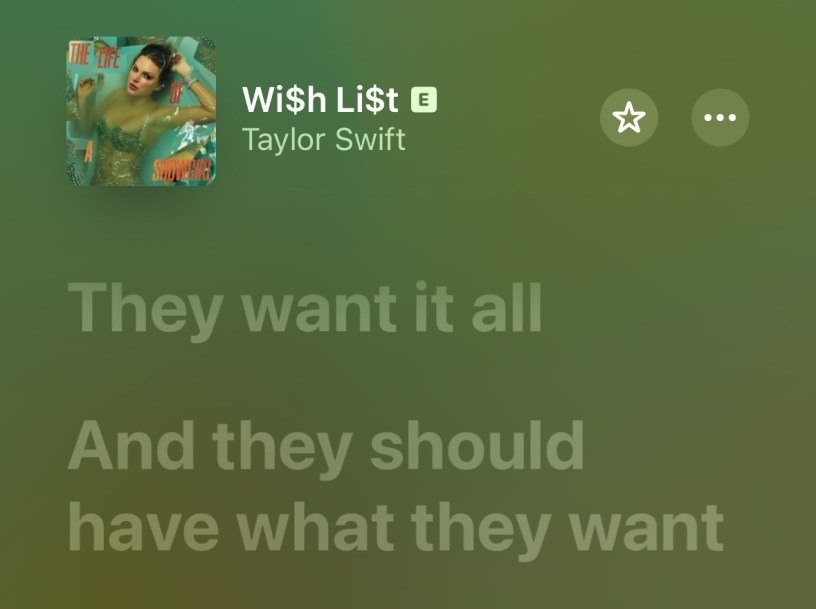
Taylor Swift’s twelfth album, The Life of a Showgirl, dropped this past Friday and – like all things Taylor Swift – was welcomed with instant controversy. What particularly caught my eye, however, was how two of the more shallow songs on this track list were picked up as signs of Taylor’s supposedly objectionable descent into MAGA-lite or MAGA affiliated behavior in recent years. Those songs, Wi$h Li$t and Cancelled!, address life goals and dreams (in this case her desire for marriage and motherhood) and the right to be friends with those who are “cancelled”. Today I will focus on the controversy surrounding the familial desires expressed in Wi$h Li$t and follow up later with a discussion of Cancelled!.
Concerns and speculations about Taylor’s “real” political leanings are not new, they have been around as long as she has been famous, in large part not because of what she says but rather more commonly how the void of her political expression allows others to project their biases and preconceptions onto her as a rhetorical flash point. Those projections are often drawn superficially from the fact she is a white, tall, rich, successful, blond woman, with blue eyes, a southern coded background, and a history of public relationships with several high profile men.
Her political imagery and the way she is perceived by our wider culture is rarely driven by her own words or professed values, but rather how her aesthetics or her very existence in the public square as a person with these physical traits and characteristics makes others feel. It is certainly true she could say or do more to clarify her own political views on specific issues or use her celebrity to guide public opinion more frequently. But the fact remains her only political activism to date has been in support of Democratic politicians or traditionally liberal political causes, the most recent example being her endorsement of Harris/Walz in the 2024 election.
I say this because the latest charge leveled at Taylor, her art, and by extension her fans or those who identify with her songs, is that she is now a Trad, or at the very least glorifying and enabling that lifestyle, and therefore critics claim she (and perhaps the fanbase that sticks with her) is well on her way to going MAGA or fascist. This is a serious concern, one which demands careful thought, because we live in a time when the social and political implications of that allegation are morally consequential and tie into vital questions regarding mutual commitments to the protection of fundamental human rights and our democratically mediated coexistence.
For the uninitiated, Trad (a shorthand for traditional) as a pop culture concept is something which originated more or less around early 2010’s online high church culture. It started, to be honest, mostly as a group of nerdy yet dramatic young people who liked things like incense and theology and some form of traditional family roles. They were largely inspired by a love of high church aesthetics and academic works and obscure theological debates, reading tomes like Pope John Paul II’s Theology of the Body or perhaps finding inspiration in Aquinas or the study of Patristics (the church fathers and mothers).
I can say all that because I was one, getting married with the full Anglican liturgy including communion in 2013 and quickly going on to have four babies in four years under the care of nurse midwives, choosing to become a stay at home mom with advanced degrees while my husband attended law school and pursued his career. I am sure there are already much better descriptions of how this modern expression of certain traditional beliefs or preferences started, who the prominent figures were, etc., but these are the highlights as I experienced them.
Trad Cath was perhaps the largest group of this movement, made up mostly of recent converts to Catholicism or those with conservative theological commitments, but it was not uncommon for these ideas and the language associated with it to percolate into the Anglican/Episcopalian, Lutheran, and other Reformed communities. As part of this movement the concept of a Trad Wife, a woman who was intentionally living those values as a wife and mother, began to emerge.
While there were certainly political implications of the earliest online expressions of these ideas, it mostly started as an avenue for personal expression or identity formation and as a way to help justify private choices for how younger religious couples wanted to organize their family and religious life. It was also initially popularized almost exclusively by highly educated religious adherents, not just men but also women, who were choosing a lifestyle freely in pursuit of their own well informed (even if naively idealized) theories of worship, vocation, and family life.
Once the online culture surrounding these ideas began to gain in popularity in the 2010’s and coinciding with the original decent into MAGA train madness, they found themselves in deeper dialogue with other traditional or conservative voices and subcultures such as mormons, low church conservative evangelicals, and natural health/life advocates. Over time, as this online movement grew, the concept of Trad became more nebulous, less tethered to any specific tradition or even necessarily a specific faith.
Instead Trad and the related Trad Wife is now part of a massive social media driven influencer community, one which covers everything from spousal relational dynamics, parenting, diet, fashion, home decorating, education, professional paths, medical choices and, yes, how all these things interconnect with political identity. I guess there are still true believers but there are also many grifters, people who use the concept for clout or financial gain. And then there are the political movements who proudly associate with the concept, all conservative and mostly all MAGA affiliated, such as the National Conservatives (NatCons) repped by Vice President JD Vance and company or the Pronatalists repped in the press by that one creepy couple that gets far too much attention.
The concept of promoting traditional marriage roles was never revolutionary or new in the context of our wider society. So, bluntly, as this online identity of Trad became more widely used it shifted from being a niche reactionary subculture within liberalizing Christian traditions to a mainstreamed reinforcement of every social impulse that seeks to limit the choices, social rights, and aspirations of all women and children and some men.
What started as a term signifying personal choice shifted into a glorification of intra community coercion, and then blossomed into a catch phrase for the political movement seeking to legislatively mandate the universal social control of women, as well as others who live outside their conception of socially acceptable or “natural” gender roles. Understandably, the concept of Trad is now widely reviled by those who do not share these values, by people who do not believe it is ethical or just or desirable to coerce or subjugate all women to the realm of homemaking and childrearing.
Thus enters Taylor Swift and her new album, written in the context of being a year into a relationship with her now fiancé, releasing a song called Wi$h Li$t where she sings to a romantic partner the most controversial lyrics in our modern era:
 I just want you, huh
Have a couple kids, got the whole block looking like you
We tell the world to leave us thе fuck alone, and they do, wow
Got me drеaming 'bout a driveway with a basketball hoop
Boss up, settle down, got a wish (Wish) list (List)
I just want you
This wish list of hers, the desire to be with her partner and settle down with a couple kids and a basketball hoop in front of a home with a driveway, is presented in contrast to many other desires expressed by people around her who “want it all”: that of the “yacht life”, “bright lights”, the presumably cosmetic procedure driven outcomes of a “fat ass with a baby face”, a “complex female character”, the film awards of the Palme d’Or or an Oscar, the freedom of “living off the grid”, “three dogs that they call their kids”, “good surf, no hypocrites”, “a contract with Real Madrid”, and raucous Spring breaks plus the ability to have “that video taken off the internet”.
As the latest christened Trad anthem, you might assume she then criticizes all these other wishes as vapid, or childish. Perhaps she calls them out as a waste of time or unfulfilling or suggests her peers are wrong to want any of that, a common perhaps even timeless theme in music and film when reflecting on the excesses of celebrity and fame. But no, in this song, before listing the familial desires born of her freshly embraced love affair, she goes on to repeatedly say about all these other people:
And they should have what they want
They deserve what they want
Hope they get what they want
Oh.
So what is going on here? Why are such basic and common desires like getting married, having kids, living in a house with a suburban coded image, suddenly offensive? Why is the mention of these other wishes presumed to be a criticism even if she says she wants people to have those things, they just aren’t for her right now?
The discourse on this topic is all over social media, in subreddits and comment sections and viral posts. Maybe these are authentic or maybe it’s more conflict and controversy driven by bots or other coordinated forces. But there is definitely a message floating around online right now, targeted at her majority female fanbase, that to merely want marriage or a committed partnership and have multiple kids is somehow wrong, that it is somehow anti-feminist, that these desires in and of themselves are Trad.
Reading over a particularly nasty exchange on this topic within the fanbase for another favorite musician of mine, Florence Welch, who is also a friend of Swift and who recently opened up about her own as yet unfulfilled desires for motherhood, I was reminded of one of the most impactful books I ever read in undergrad: Public Man Private Woman by Jean Bethke Elshtain.
In this intellectual history of the role of feminism in political thought, Elshtain crucially declares, “I begin with a reaffirmation: familial ties and modes of childrearing are essential to establish the minimal foundation of human, social existence…the family’s status as a moral imperative derives from it’s universal, pan-cultural existence in all known past societies. We are not dealing with a tangential, episodic cultural form but a transhistorical one” (327).
It is a weakness, she explains, of feminism to at times dismiss this universal, pan-cultural, transhistorical longing and experience. The desire to build and sustain a family is not a partisan or outdated endeavor and it should not be reduced as such. To acknowledge the presence of this desire throughout history and around the world is not to mandate or prescribe it as a necessary goal for all people, but rather to affirm that it is a common and ever present part of our human expression and cultural formation. Not all people desire to build their own families but all people are – in the best of circumstances – meant to start out in the family, to be reared and morally formed by the family, and therefore the family in it’s many forms should not be overlooked or viewed as somehow separate or at odds with the goals of feminism.
Later on she tells a story about attending a feminist gathering in the 1960s where her friend was belittled while trying to tease out the dual identities of being both a feminist and a mother with the line “We will have no diaper talk here. We’re here to talk about women’s liberation” (334). This is the exact type of feminism Elshtain wishes to warn against and this is the type of feminism we see right now as the online commentariat declares Taylor Swift simply cannot still represent a fight against the Patriarchy while also engaging in her own form of lowly, uninspired, and embarrassing “diaper talk”.
Insightfully Elshtain also noted how “Too frequently mothering has been over assimilated to what feminists call “the shitwork.” Mothers were demeaned under the guise of “liberating” them. In many early feminist accounts mothering was portrayed as a condition of terminal psychological and social decay, total self-abnegation, physical deterioration, and the absence of self-respect” (333).
There is, I think, a deep fear that successful women like Swift are choosing their own subjugation or debasement in expressing their desire for motherhood or, even further, actually taking steps towards marriage and child rearing. That somehow the new admission she “lied” when she said she did not believe in marriage in the past and her openly expressed desire for motherhood now renders her less feminist, less admirable. I worry the message being sent, in labeling such simple lyrics like those in Wi$h Li$t as Trad, is that to want and talk about anything resembling a “traditional” family life is itself akin to aligning with nascent fascism.
That kind of distain for the role played by mothers and families in society is not just wrong on the merits in assuming women who desire these transhistorical milestones in life are automatically anti-liberation, it is also counterproductive to any effort which seeks to uplift all women and fight for our collective rights in the face of regressive social movements such as contemporary Trad culture.
Elshtain notes, “The reflective feminist, then, begins her considerations with the important, not trivial, fact that Americans remain committed to family life and that it would require major social coercion and manipulation to destroy that commitment” (332). Just as it would require mass coercion to enforce the Trad political project, so would it require mass coercion to dissuade a majority of people from ever pursuing the desire to “settle down” with a spouse and have a family.
We cannot and should not cede that desire to one side of a culture war. It is important to model how wishes like those expressed by Swift can be lived in ways which also affirm and advance equality and justice within the family system and among society at large.
In fact a divisive culture war on this subject, one which alienates people living “traditional” social lives as automatically part of the conservative political movement, is what real Trads want. That is why MAGA figures like VP Vance jumped in to congratulate Swift and her fiancé Travis Kelce on their engagement after she was previously targeted as an object of derision for being unmarried, childless, and too focused on her work. It is to the political benefit of real Trads, people actively engaged in supporting an oppressive political movement, to accept their framing that marriage and family is “theirs” and singleness or alternative lifestyles exist in a separate category only for “the radical left”. We should forcefully reject any attempt to divide our core identities and dreams in this way and pit us against each other on their terms.
Moreover, Elshtain helpfully redirects this debate in reminding us that “It is the isolation and debasement of women under terms of male dominated ideology and social structures that must be fought, not the activity, the humanizing imperative, of mothering, or of being a parent, itself” (333). We yell “Fuck the Patriarchy” because we want to dismantle a predatory social system, not punish an individual for their personal familial choices or dreams or demean the entire generic concept of motherhood or family life.
Ultimately we should want a world where people are free to choose for themselves the kind of wish lists they draw up and pursue. We should build social systems which enable maximum freedoms for self expression and which minimizes obstructions to our personal change or growth overtime. That’s a core provision of diversity and inclusion, a dream of empowering both the pan-cultural norms like family and the potentially rarer but no less valid dreams of three dogs you call your kids. Like Elshtain notes “we are all impoverished if all of life falls under a single set of terms” (335), a line which surely agrees with Swift’s belief that everyone else should get what they want out of their private or professional lives, even if what they want is radically different than her own desire for “a best friend who I think is hot”.
Taylor Swift wants a world where we are all free to choose what we want, whether those desires are born from the heights of pop stardom or the most basic of domestic dreams. That vision is not Trad. It is actually the opposite of being Trad. For Trads, as an evolving collective, now want a world where we have no choice, where we are all homogenized and forced to draw up wish lists that look nearly identical. The defining core of being Trad in 2025 is not being in a heterosexual marriage or having kids or even staying home with those kids or delaying professional goals or moving to the suburbs, but rather believing everyone else must live their lives exactly as they do. To be Trad is to believe other people are not free to choose their own divergent loves or lives.
Whatever else you think of Taylor Swift, her latest album, or the song itself, Wi$h Li$t in its simple affirmation of choice, the acknowledgment of wildly divergent yet explicitly “deserved” goals and desires, is the antithesis of Trad. It’s not a complex idea nor is it particularly original, but in today’s political climate it is one we need to embrace and walk out with greater commitment for our mutual flourishing and freedom.
I hope all those people who hate on this song get whatever they want in life however different it is from my own wish list, and I think – at least based on what we know of her as a person – Taylor Swift wants that for you too.
 Finding Tangle